
Planting Instructions for Lady's Slipper Orchids
pdf version for printing
division - video
Climate zone
Frosch® Cypripedium hybrids can be grown in all areas where temperatures do not regularly exceed 33°C (91°F) in summer and remain below +5 °C (40°F) for 2-3 months in winter. Temperatures even below -25°C (-13°F) present no problem, given sufficient snow cover (down to hardiness zone 3; scroll down on www.plantmaps.com to your country). No separate protection during winter is required - lady's slipper orchids are completely hardy.
However, once they have started growing, the leaves are sensitive to frost. Therefore, protect the garden orchids by covering with buckets or fleece if there are late frosts or snowfall in spring.
In summer they can survive occasional temperatures of 40°C (104°F), provided such conditions are the exception rather than the rule and provided they are planted in a shady place. If you need plants which are better equipped to survive prolonged periods at higher temperatures, then we recommend hybrids with Cyp. kentuckiense (such as Dietrich, Gabriela, Philipp) or Cyp. reginae (e.g. Ulla Silkens).
Planting site
Semi-shade, no direct sun at midday. A very suitable place would also be on the north side of a building. Most cypripediums are woodland plants and therefore prefer cool sites, which do not become too dry and hot during summer. Places where ferns thrive are also suitable for lady's slippper orchids.
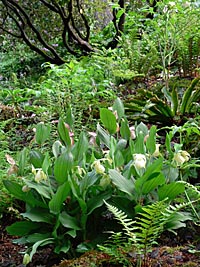
Don't plant your cypripediums close to trees or big shrubs because their roots are effective competition for water and nutrients!
Soil
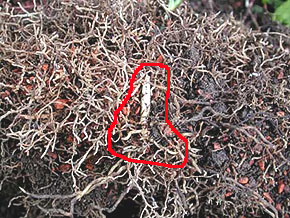
Basically, Cypripedium hybrids grow well in most garden soils. Lady's slipper orchids prefer a well-aerated, crumbly soil structure (10 cm / 4 inches deep) and medium moisture conditions. Dense and loamy soils should be improved with mineral materials such as crushed clay pebbles or lava. If the planting site is too wet, a drainage layer with crushed clay pebbles or crushed lava should be added.
In regions with constant winter dampness, a well-ventilated rain cover or a pure mineral soil mix is recommended. Otherwise, there may be losses due to rot.
In sandy soils which dry out rapidly it is recommended to increase water retention by mixing in perlite, Seramis® or Isolite®.
Covering the soil with a layer of conifer needles (e.g. spruce or pine) has a favourable effect on structure and moisture. Lady's slipper orchids are completely hardy - no separate protection during winter is required.
Planting
Autumn is the best season for planting. Spread out the roots in the upper 10 cm (4 inches) of the soil, the rhizome 2-3 cm (1 inch) below the surface, shoot buds upwards.
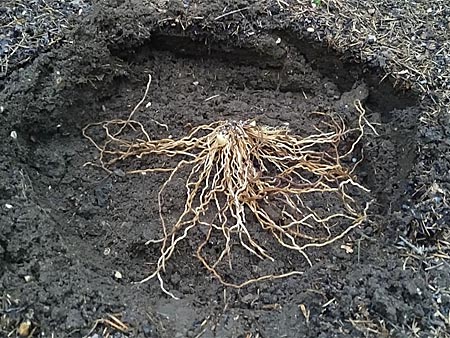
Fill in the remaining substrate without compressing it, and water thoroughly.
You may like to watch our instructional film about the planting of cypripediums.
Plant care
Fertilize your lady's slipper orchids regularly in spring, necessary for strong growth. Use any granulated commercial garden fertilizer, best are those with a long-term effect. Apply the same quantity as for other perennials too, not less. After flowering the need for nutrients is low, but at the beginning of the growth season the need is high. Leaf coloration is a good indicator; leaves should always be bright green. A yellowish green indicates nutrient deficiency or too much sun. Compost is not recommended. Orchid fertilizers do not contain enough nutrients.
The soil should never dry out completely, therefore in dry summers careful watering is recommended.
The shoots die back in autumn and should then be removed by diagonally pulling them out of the ground or cutting the stems off.
Cypripedium clumps should be divided every few years in order to keep them vital and healthy. For details, please see our dividing advice and our video on this topic.
Growing cycle
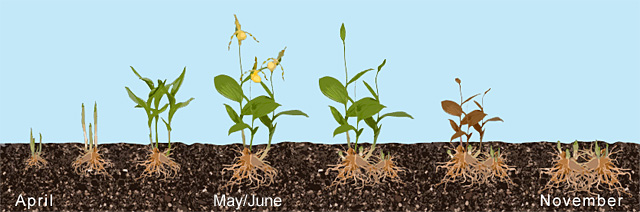
Lady´s slippers differ somewhat in their growth from average perennials. The shoot doesn´t grow all year but is already fully formed after sprouting. Growing conditions in the current year determine the size of the shoot in the following year and whether it will flower. During summer the plant forms the shoot bud for the next season and new roots. Good growing conditions are particularly important during this phase.
Protecting your lady's slipper orchids
Slugs can wreak havoc within one night. Particularly during springtime special protection is indispensable. The safest methods for controlling slugs are a slug fence or a barrier consisting of a vertically mounted copper plate (a few centimetres high), alternatively Etisso® Slug & Snail-Lentils.
Combination with other plants
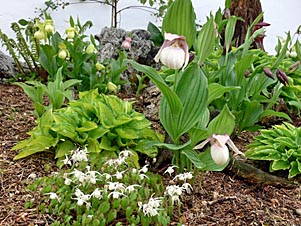
Lady's slipper orchids look best in combination with slow-growing ferns, barrenwort (Epimedium) and small Hosta species (see photo). They cannot compete with vigorously-growing perennials, shrubs or trees. Leptinella (syn. Cotula) has turned out to be a suitable and good groundcover. This plant forms loose green carpets which do not inhibit the growth of the Cypripedium shoots.